THE JOURNAL
January should not taste like August
What seasonality gives back to the kitchen
FLAVOURS SHAPED BY IBIZA’S TERROIR & SEASONS

August is easy to love
Tomatoes warm from the sun. Figs beginning to soften on the tree. Melons heavy with sweetness. Basil growing faster than it can be cut. Grapes colouring on the vine.
Abundance is visible everywhere.
January asks you to look differently.
The tomato plants have gone. The melons are a memory. But the landscape has not stopped feeding the kitchen.
Citrus hangs among dark green leaves. Avocados move through their season. Fennel pushes through the cooler soil. Broad beans and peas grow where summer crops once stood. Rosemary flowers. Brassicas, roots, bitter leaves and herbs bring an entirely different spectrum of flavour.
The palette has changed.
That is the point.
January should not taste like August.
A living food landscape should not spend the year trying to reproduce summer.
It should give every season its own kitchen.


Seasonality is not scarcity
We have become accustomed to interpreting seasonality as restriction.
If tomatoes disappear, we have less.
If strawberries are not available, something is missing.
If summer ends, abundance ends with it.
But that is only true when we measure abundance by the availability of a few familiar ingredients.
A sufficiently diverse landscape tells a very different story.
Fruit and nut trees. Citrus. Vines. Berries. Annual vegetables. Perennial vegetables. Roots. Leaves. Legumes. Herbs. Edible flowers. Seeds. Shoots. Blossoms. Different cultivars of the same crop. Early selections. Late selections. Different edible stages of the same plant.
Once all of those layers begin operating together, seasonality stops feeling like subtraction.
It becomes succession.
Something ripens. Something flowers. Something disappears. Something else begins.
The landscape does not become empty. It changes character.
That is what Rawness means by:
Available 365 days a year.
Never the same 365 days a year.


Winter has its own kind of abundance
Mediterranean winter is not a dormant northern landscape.
It is cooler, quieter and softer, but still highly productive.
The winter kitchen can move through oranges, mandarins, lemons, grapefruit, kumquats and avocado; through artichokes, fennel, chard, spinach, kale, cabbages, broccoli and cauliflower; through lettuces, escarole and bitter leaves; through carrots, beetroot, radish and turnip; through leeks, spring onions, peas and broad beans.
Then there are the ingredients that rarely receive the same attention as fruit and vegetables: rosemary, thyme, sage, parsley, coriander, bay, mint, fennel fronds, chives, borage, calendula and nasturtium.
And even this is only a fragment of what a deliberately diverse winter landscape might carry.
The flavours are different from summer.
There is bitterness.
Anise from fennel. The resinous perfume of rosemary. The brightness of citrus peel. Peppery leaves. Sweetness developing in roots and brassicas. The richness of avocado. Green peas and tender broad beans.
The colours change too.
Deep greens. Silver leaves. Citrus yellow. Mandarin orange. Burgundy beetroot. Pale fennel. Purple brassicas. White cauliflower. Blue and orange edible flowers.
Winter does not need tomatoes to be interesting.
It needs to be allowed to be winter.
Then the landscape begins to open
Spring does not arrive as a switch.
It moves through the property gradually.
Almond blossom can appear while winter vegetables are still being harvested. Peas and broad beans flower. Strawberries begin producing more strongly. Citrus blossom fills the air. Avocado enters flower. Stone-fruit trees move through white and pink blossom. Grapevines wake. Mulberries leaf out. Pomegranate prepares another cycle.
Meanwhile, the kitchen begins receiving a softer, younger palette.
Asparagus. Artichokes. Tender peas. Broad beans. Young garlic. Spring onions. Fresh leaves. Loquats. Strawberries. Mulberries. The first apricots and other stone fruit where cultivar and site allow. Courgette flowers begin appearing. Dill, chives, mint, coriander, parsley and lemon balm move through another phase of growth.
Green becomes brighter.
Flavours become more tender.
The landscape starts smelling different before the kitchen tastes different.
And this may be one of the greatest gifts of growing food where you live.
You experience a season before you eat it.
You see the blossom that will become the fruit.
You notice the grapevine before there is a grape.
You watch the first flowers on the courgettes.
Anticipation becomes part of eating.
Summer does not simply bring more. It brings another vocabulary
Then the landscape changes gear.
Heat-loving plants begin taking over the annual garden. Trees that spent months preparing fruit suddenly enter the kitchen. Vines become heavy. Herbs become intensely aromatic.
Tomatoes arrive — but not one tomato.
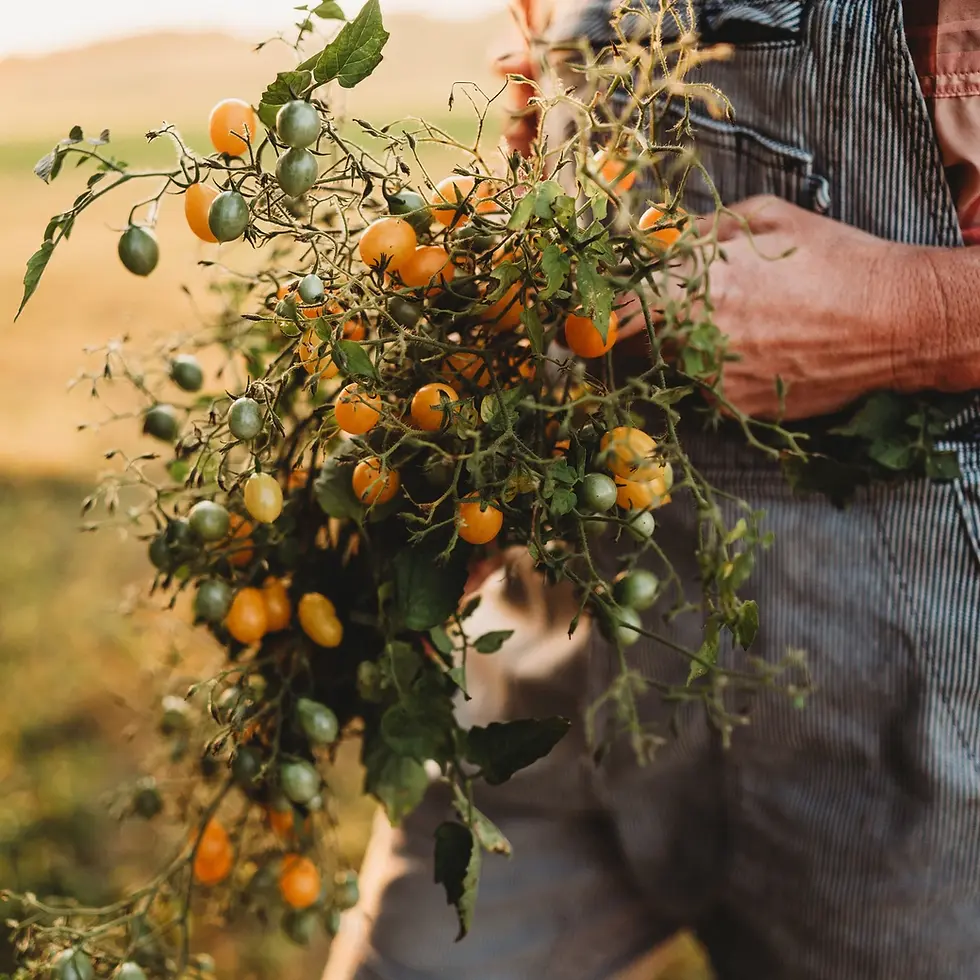
Cherry types. Slicers. Beefsteaks. Sauce tomatoes. Red, yellow, orange, purple, striped and almost black cultivars. Sweet ones. Acidic ones. Dense ones. Juicy ones.
Then peppers and chillies.
Aubergines in different shapes and colours.
Courgettes and their flowers. Cucumbers. Green beans and climbing beans. Okra. Sweetcorn. Melons. Watermelons. Basil in several forms. Mint, oregano, marjoram and tarragon.
Apricots, peaches, nectarines and plums overlap with mulberries and berries. Brevas become figs. Grapes begin. Almonds develop. Different melons bring different perfumes and textures.
Fennel changes again: leaves become flowers, flowers become pollen, pollen becomes seed.
Coriander that once supplied fresh leaves can now offer flowers and green seed.
The same landscape that tasted leafy and green several months earlier has become juicy, sweet, acidic, floral, aromatic and fruit-driven.
Summer abundance is real.
But its beauty lies partly in knowing that it cannot last forever.
Autumn does not close the year. It deepens it
There is a moment when summer and autumn exist on the same table.
Late tomatoes can still be coming from the garden while figs and grapes are joined by pomegranates.
Peppers and aubergines remain while pumpkins and winter squash begin to take over.
Pears and apples enter the orchard palette. Almonds and carob arrive. Jujube may appear. Prickly pear belongs to another part of the Mediterranean spectrum. Persimmon develops its deep orange colour. Quince brings an aroma entirely unlike summer fruit. Olives begin another harvest story.
Sweet potato appears below ground while the beds above it begin moving back towards beetroot, chard, lettuces, fennel, roots and brassicas.
Basil slowly recedes.
Coriander and parsley return.
Rosemary and sage remain.
And eventually citrus and the next avocado season begin moving back into the landscape.
The circle has not closed.
It has turned.
The landscape is also feeding something else
There is another audience for this changing palette.
Bees.
Butterflies.
Hoverflies.
Beetles.
Lacewings and other beneficial insects.
They experience the seasons through flowers rather than through our harvest baskets.
A diverse food landscape can therefore be designed not only around when we want to eat, but around when the landscape needs to flower.
Almond blossom does not arrive at the same moment as citrus blossom.
Rosemary may flower when very different crops are still vegetative.
Broad beans and peas flower through cooler periods.
Stone fruit opens in spring.
Citrus and avocado follow their own flowering rhythms.
Courgettes, cucumbers, melons and beans flower as the annual garden moves towards summer.
Herbs such as thyme, rosemary, oregano, fennel, coriander, dill and basil can be allowed to flower rather than being treated only as leaves for the kitchen.
Pomegranate flowers.
Borage flowers.
Nasturtium flowers.
Calendula flowers.
The flowering sequence can continue through a landscape composed of trees, shrubs, herbs, annual crops, perennial plants and deliberately retained habitat.
Again, none of these plants alone is the answer.
The value lies in overlap.
Research in agricultural landscapes supports this principle: pollinators benefit when floral resources are diverse and available across different parts of the growing season, rather than appearing in one short pulse. Flower abundance and plant diversity can increase the presence of wild bees and butterflies, while different habitats and flowering periods complement one another through time.
Rawness therefore has another reason to avoid the simplified landscape of one crop, one cultivar and one flowering period.
The kitchen benefits from diversity.
So can the living system around it.
Some flowers are for us. Others are allowed to continue
There is something wonderfully counterintuitive about deliberately not harvesting everything.
A coriander plant can be eaten as leaf.
Or some of it can remain.
It flowers.
The flowers become part of the insect landscape.
Then come green coriander seeds — a completely different culinary ingredient.
Later those seeds mature again.
Fennel can be frond, bulb, flower, pollen, green seed or dry seed.
A courgette can be eaten as a flower or allowed to become fruit.
Radish can move beyond the root into flower and seed pod.
A plant does not necessarily represent one ingredient.
And its value does not necessarily end with our plate.
That is why the Rawness landscape is not simply organised as a production machine.
Some plants are allowed to flower because flowering has value.
Some are allowed to seed because seed has value.
Some flowers support insects.
Some become next year's propagation material.
Some biomass returns to the soil.
Different stages serve different parts of the system.
The approved Rawness framework describes precisely this principle as harvest-stage diversity: a single crop can provide several culinary ingredients at different stages, while flowering and habitat can provide ecological functions at the same time.
Pollination becomes architecture
This matters particularly in the orchard.
More flowers do not automatically mean better pollination, and different crops have very different reproductive biology.
But when pollination matters, cultivar selection can be designed around it.
Some fruit trees require compatible cultivars flowering at the same time. Others are self-fertile but can still benefit from having multiple genetic lines for other reasons. Avocado has complementary flowering types. Kiwi and pistachio follow still different reproductive systems.
So Rawness does not apply a generic rule such as plant two trees.
We ask a more useful set of questions.
When does this cultivar flower?
What else is flowering at that moment?
Does it require another compatible cultivar?
Are pollinating insects likely to find food and habitat around it?
Can another cultivar simultaneously improve pollination, extend the harvest and introduce another flavour?
That is where ecology and the kitchen begin to overlap.
Several plants. Several cultivars. Several harvest windows. Several flowering windows.
The approved Rawness framework already establishes this as the design preference, while requiring pollination to be assessed crop by crop rather than assumed.
Diversity can be tasted — and seen before it is tasted
When we talk about edible diversity, it is easy to picture a list.
Twenty vegetables.
Ten fruits.
Six herbs.
But a living landscape does not present itself as a spreadsheet.
It presents itself as colour.
White almond blossom.
Yellow courgette flowers.
Blue borage.
Orange calendula.
Purple aubergines.
Scarlet tomatoes.
Dark figs.
Pale green fennel.
Blackberries staining fingertips.
Ruby pomegranate seeds.
Silver olive leaves.
Deep-green citrus canopies carrying orange and yellow fruit.
It presents itself as scent.
Orange blossom.
Tomato leaf.
Basil.
Rosemary warmed by sun.
Mint crushed between fingers.
Fennel pollen.
Ripe melon.
A fig opening on the tree.
It presents itself as flavour.
Bitter.
Sweet.
Acidic.
Peppery.
Floral.
Herbal.
Resinous.
Aniseed.
Nutty.
Green.
Juicy.
Earthy.
And because those qualities keep changing through the year, the landscape never gives the kitchen quite the same palette twice.
The pleasure of missing something
Modern food has largely trained us out of anticipation.
There is always another tomato.
Another strawberry.
Another bunch of asparagus.
Another avocado.
There is extraordinary convenience in that.
But permanent availability can also remove one of food's quieter pleasures:
the return.
The first fig matters because there was a last fig.
The first tomato deserves attention because winter did not pretend to be summer.
The smell of citrus blossom means something because it belongs to a particular part of the year.
A pomegranate appearing again connects the kitchen to a season that has returned.
Living with food means sometimes missing it.
Waiting for it.
Watching for it.
And then having too much of it.
That excess has a place too.
It can be shared, dried, fermented, preserved or gathered into Rawness Pantry Goods.
The pantry allows a harvest to travel into another season.
It does not erase the season it came from.
A different definition of abundance
Rawness is not trying to make August last twelve months.
We are trying to create something far more interesting.
A landscape containing enough layers, species, cultivars, flowering periods, edible stages and harvest windows that the kitchen continues discovering something different as the year turns.
Fruit trees above.
Berries and shrubs beneath them.
Vines climbing.
Roots below ground.
Annuals moving through succession.
Perennial herbs remaining.
Flowers opening.
Seeds forming.
Some ingredients appearing briefly.
Others returning for months.
Some plants producing several different ingredients before their cycle is complete.
And within every species, diversity can begin again.
The examples in this article are therefore exactly that: examples.
They are not the boundaries of a Rawness landscape.
The actual edible palette can become far wider, shaped by the property, its soil, water, microclimates, mature trees, cultivars, propagation and everything Rawness learns there through time.
The ambition is not to collect plants without purpose.
It is to create the greatest useful diversity that the living system can successfully carry.
Enough difference that every season develops a character of its own.
Enough flowering that the landscape offers resources to more than ourselves.
Enough change that the kitchen never becomes indifferent to what is growing outside it.
January should not taste like August.
Because when every season is allowed to become itself, there is far more to look forward to.