THE JOURNAL
The Flavour of Diversity
How cultivar transforms a single ingredient into a culinary palette.
FLAVOURS SHAPED BY IBIZA’S TERROIR

A tomato is a useful word.
But it tells you surprisingly little about what you are actually going to eat.
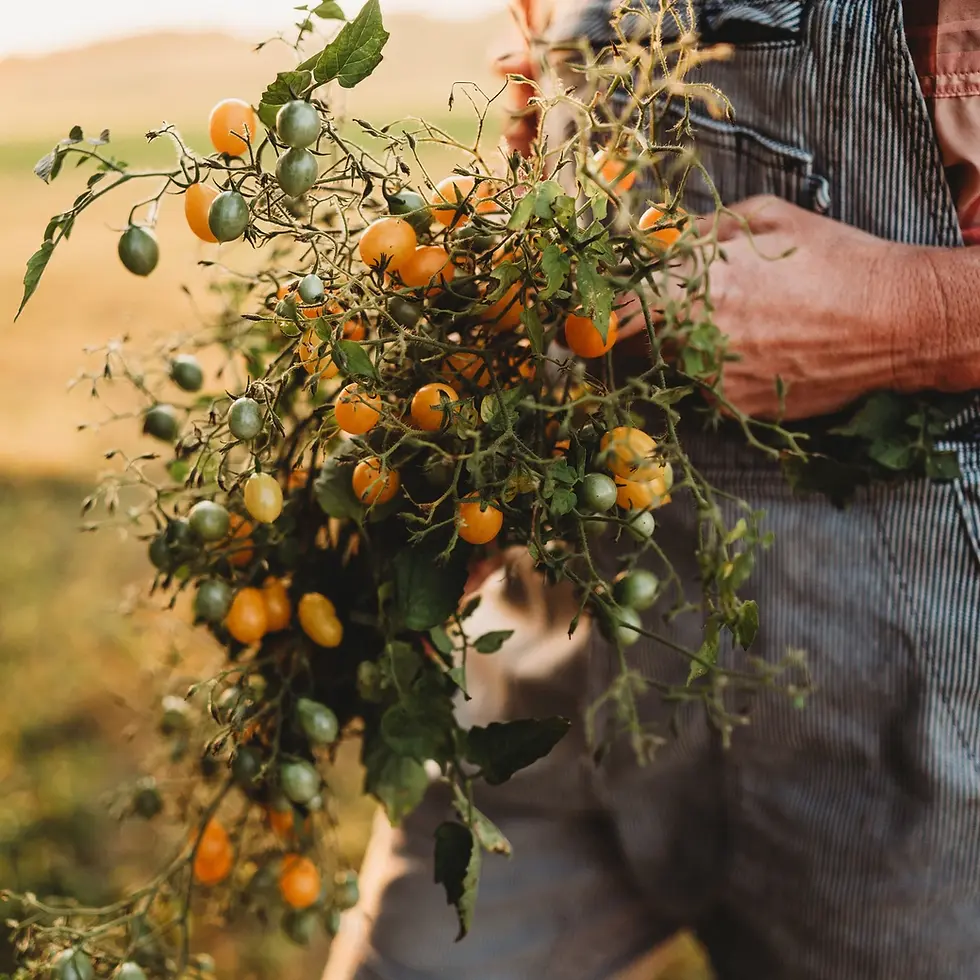
Two tomatoes can belong to the same species and still offer completely different experiences: one dense and almost savoury, another bright and acidic; one intensely aromatic, another delicate and sweet; one built for slicing, another for sauce, another best eaten warm from the plant.
The difference is often the cultivar.
And for Rawness, that difference matters.
We do not think about edible diversity only as the number of different crops growing on a property. Tomatoes, figs, grapes, melons, chillies and avocados each contain another layer of diversity within themselves.
Diversity begins again inside every ingredient.
This is what we call Diversity Within Diversity.

Fig. 01 — A study of essential forms and natural light.

Fig. 02 — Observing the tactile qualities of the essential.
The cultivar is part of the ingredient
Walk through a supermarket and a tomato is usually presented as a category.
Walk through a sufficiently diverse living food landscape and that category begins to dissolve.
There are different fruit sizes, colours, textures, sugar–acid balances, aromas, skin thicknesses and culinary uses. They mature differently. They respond differently to heat. Some fruit early, others later. Some deserve to be eaten raw; others reveal themselves through cooking.
The same principle applies far beyond tomatoes.
A fig is not simply a fig.
A grape is not simply a grape.
An avocado is not simply an avocado.
For Rawness, choosing what to grow therefore happens at a finer resolution than species alone.
The objective is not to collect varieties for the sake of collecting them. It is to build the widest useful culinary diversity that a particular piece of land can carry well: different flavours, different harvest moments and different roles in the kitchen.
That principle sits at the centre of the Rawness growing architecture.


Why older varieties matter
Rawness cultivates almost exclusively from open-pollinated heirloom and heritage varieties.
But not because old automatically means better.
That distinction matters.
Older cultivar collections are valuable because they can preserve sensory characteristics and genetic variation that are less common in mainstream commercial production. Modern crop breeding has understandably had to solve different problems: yield, disease resistance, firmness, visual consistency, shelf life and the ability to survive harvesting, packing, transport and retail.
Flavour has not always been the only priority.
A major study of 398 modern, heirloom and wild tomato accessions found that modern commercial tomatoes contained lower concentrations of many important flavour-associated chemicals than older varieties. The researchers identified differences in sugars, acids and volatile aroma compounds that contribute to the way a tomato is perceived.
But there is an important counterpoint. Later European research found modern cultivars that performed as well as, and sometimes better than, traditional varieties in sensory testing. Heirloom status is therefore not a guarantee of extraordinary flavour.
That is exactly why Rawness does not grow a cultivar simply because it has an old name.
A cultivar has to earn its place.
Through flavour. Character. Adaptation. Season. Culinary use. Or another meaningful role within the living system.
Heritage gives us an extraordinary library to explore.
The palate still makes the final selection.
Flavour is more complicated than sweetness
The flavour of a tomato does not come from a single molecule.
Sweetness and acidity form part of its structure, but much of what we experience as flavour comes through aroma. Tomatoes contain many volatile compounds that reach our olfactory system as we eat. Some occur in tiny quantities yet have a disproportionate influence on whether we perceive a tomato as aromatic, fruity, green or even sweeter.
Research has shown that aroma volatiles can increase the perception of sweetness independently of the actual sugar concentration.
This is why two tomatoes with similar sugar levels can taste dramatically different.
It is also why Rawness is interested in flavour as something far richer than Brix or sweetness alone.
We are looking for expression.
The balance between sweetness and acidity. The aroma released when the fruit is cut. Texture. Ripeness. Persistence. The character that remains after the first bite.
And then we grow another cultivar beside it that expresses the tomato differently.
Suddenly one vegetable has become a palette.
Flavour is valuable enough on its own
There is a temptation to turn strong flavour into proof of everything else.
We should resist it.
A deeply flavoured tomato is not automatically a scientifically proven more nutritious tomato. Ripening, genetics, temperature, sunlight and growing conditions can affect sugars, acids, carotenoids, vitamin C and other secondary metabolites in different ways. They do not all rise and fall together.
Flavour is already an extraordinary form of quality.
It tells us that the fruit has a particular sensory composition. It gives the kitchen something worth working with. And when ingredients can remain on the plant until the appropriate stage of maturity, the grower and chef gain control over something a supply chain inevitably has to compromise: the exact moment of harvest.
Flavour deserves to be selected deliberately.
The avocado makes the principle visible
Avocado shows how Diversity Within Diversity becomes more than a question of taste.
There are hundreds of named avocado cultivars. Familiar examples include Hass, Fuerte, Reed, Bacon, Pinkerton and Zutano.
They do not all behave alike.
Avocado cultivars are classified into A and B flowering types. The flowers alternate their female and male phases at different times of day. Under suitable conditions, combining compatible A- and B-type cultivars can increase the availability of pollen during flowering and may improve fruit set. Hass and Reed are A types; Fuerte and Zutano are B types.
Their harvest periods also differ substantially. Earlier, middle and later-maturing cultivars can be combined so that the avocado season is not defined by one tree and one short window.
And the fruit itself changes.
Cultivars differ in shape, skin, oil content, texture and eating quality. Reed, for example, is a very different avocado from Hass; UC avocado specialists describe it as notably creamy and nutty when harvested at the right stage.
One decision, planting several appropriate cultivars rather than repeating a single one, can therefore create several forms of value at once:
a longer season,
greater culinary choice,
better pollination architecture where relevant,
and less dependence on one genetic line.
That is Diversity Within Diversity in practice.
The precise cultivars and timings still have to belong to the site. What works in California cannot simply be translated into an Ibiza harvest calendar. Soil, water, microclimate, flowering overlap and local performance determine the final design.
The principle travels. The calendar does not.
Several plants. Several cultivars. Several moments.
Rawness generally prefers several cultivars within an important crop where the land and biology allow it.
Not because maximum variety is the objective.
Difference must have a purpose.
One tomato may bring acidity. Another sweetness. Another aroma. Another texture. An early cultivar begins the season; another carries it through summer; a later line keeps producing as the first begins to disappear.
The same thinking can shape figs, grapes, citrus, stone fruit, chillies, aubergines, melons and many other parts of the living pantry.
Over time, the landscape itself becomes part of the selection process.
Which cultivar tasted exceptional here?
Which handled the hottest weeks?
Which ripened at a moment when the kitchen had little else from that crop?
Which deserves to be propagated?
Which looked remarkable but tasted ordinary?
Which simply did not justify its water, space or attention?
Rawness observes, compares, retains, propagates and replaces.
The palette becomes more precise with every season.
A living pantry can afford to be specific
The conventional food system has good reasons to simplify.
A category such as tomato has to pass through growers, wholesalers, logistics, retailers and consumers. Uniformity has value when food has to travel.
A living pantry operates under a different set of constraints.
The ingredient may only have to travel a few steps.
That changes what we are free to select for.
Fragility becomes less problematic. Irregular shapes become irrelevant. Different ripening windows become useful. A variety does not need to perform for a supply chain if its destination is the kitchen beside the garden.
And suddenly the question changes.
Not:
Do we grow tomatoes?
But:
Which tomatoes deserve to grow here?
Which flavours?
Which textures?
Which moments of the season?
Which expression of this particular land?
That is the difference between growing a list of crops and developing a culinary landscape.
A tomato is never just a tomato.
It is a cultivar, a season, a moment of harvest, and one flavour among many that the land is capable of producing.
A tomato is never just a tomato.